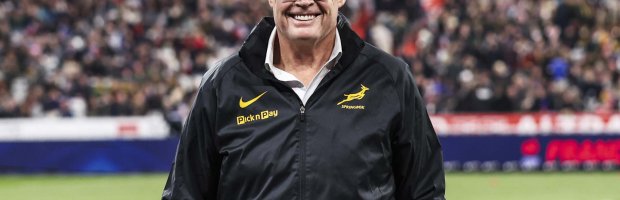
Rassie has betrayed his Boks
- 84

Rassie Erasmus demands discipline, accountability and team-first values, yet abandoned all three in an unnecessary attack on match officials.
Erasmus has done his Springboks dirty.
His latest attack on match officials was selfish, unprovoked, indulgent and a betrayal of everything he demands of his players.
For eight years, Erasmus has built a culture in which nobody is bigger than the team. He demands discipline, emotional control and accountability.
Yet, in Dublin on Monday, he abandoned every one of those principles.
He put himself first. His anger first. His obsession with match officiating first.
And now his players and management must pay the price.
World Rugby has suspended Erasmus for six international matches.
SA Rugby has requested a full misconduct hearing, but Erasmus should never have put his employers or players in this position.
There was absolutely no need for his outburst.
The Springboks lost 21-19 to France. They missed a conversion that would have levelled the scores and had enough opportunities to win.
Erasmus also got his selections wrong, changing his starting front row an hour before kick-off before admitting to indecision.
Instead of taking ownership, he sought refuge in that familiar narrative about match officials.
Erasmus claimed 17 knee-drop tackles went unpunished against France and questioned whether manipulation explained the TMO’s failure to intervene.
He knew the consequences of making such accusations.
The world’s best coach behaved without regard for consequence – precisely what he would never tolerate from a player.
And for what?
The Springboks are world champions, the world’s No 1-ranked team and have enjoyed a magnificent year, including a historic 3-1 series triumph against the All Blacks.
They didn’t need their coach manufacturing controversy to deflect from a two-point defeat.
Erasmus has become almost untouchable in South African rugby. Two World Cup titles and the transformation of the Springbok brand have earned him extraordinary loyalty.
But greatness does not excuse petulance or indulgence.
He would never tolerate a player repeatedly compromising the team through ill-discipline, regardless of reputation.
Why should the coach be exempt?
Whatever happens at the full hearing, it won’t change the selfishness of his actions.
No player forced his hand. No journalist provoked him into suggesting manipulation.
Those were his choices.
The most damning aspect is that this was entirely avoidable.
Erasmus has preached accountability for eight years. Yet, without pressure or provocation, he self-destructed.
And his Springboks have been left to deal with the consequences.